Retractable Coat Hooks for Narrow Entryways: Lessons From IKEA PS 2026
A narrow entryway does not need another coat stand on the floor. IKEA's PS 2026 retractable hook rail has attracted renewed attention in October 2026 because its hooks disappear into a shallow birch strip when they are not needed. But the interesting small-apartment question is not how flat a rack looks empty. It is whether your hallway still works when the coats, bags and keys of a normal weekday are hanging on it. This guide turns that design idea into a measurable decision.
A retractable wall rail can be a smart choice when you are allowed to drill, have enough uninterrupted wall for its length and mainly need occasional hooks. Measure the rail's closed depth AND the deepest coat or bag when loaded. For IKEA PS 2026, the official Spanish listing gives 76 cm length, 10 cm height, 2.6 cm depth and five hooks rated at up to 4 kg each. The rail still requires suitable secure wall fixings, and a loaded coat can project far beyond the 2.6 cm rail.

- Why this 2026 hook rail is worth a closer look
- Measure the wall before comparing hook designs
- The two-envelope test: folded versus fully loaded
- Compare retractable hooks, fixed pegs and a freestanding rack
- Check the weight limit without turning it into a total-capacity claim
- Make the hooks part of a landing zone, not the whole entryway
- What renters should do before drilling
- A five-minute buying decision you can repeat
Why this 2026 hook rail is worth a closer look
IKEA PS 2026 is not a newly launched October product: the wider collection appeared earlier in 2026. What has made this particular rail newsworthy again is fresh coverage on 21 October focused on tiny hallways. The underlying idea is useful well beyond one brand: storage that has a different footprint when empty than when in use.
The IKEA Spain product page describes five self-retracting hooks in a solid-birch rail designed by Ellen Hallström. Its stated dimensions are 76 × 10 × 2.6 cm (length × height × depth), and the published maximum is 4 kg per hook. Screws for wall mounting are sold separately. Availability, price and the exact fixing requirements can vary by country, so check the current local listing before making a buying decision.
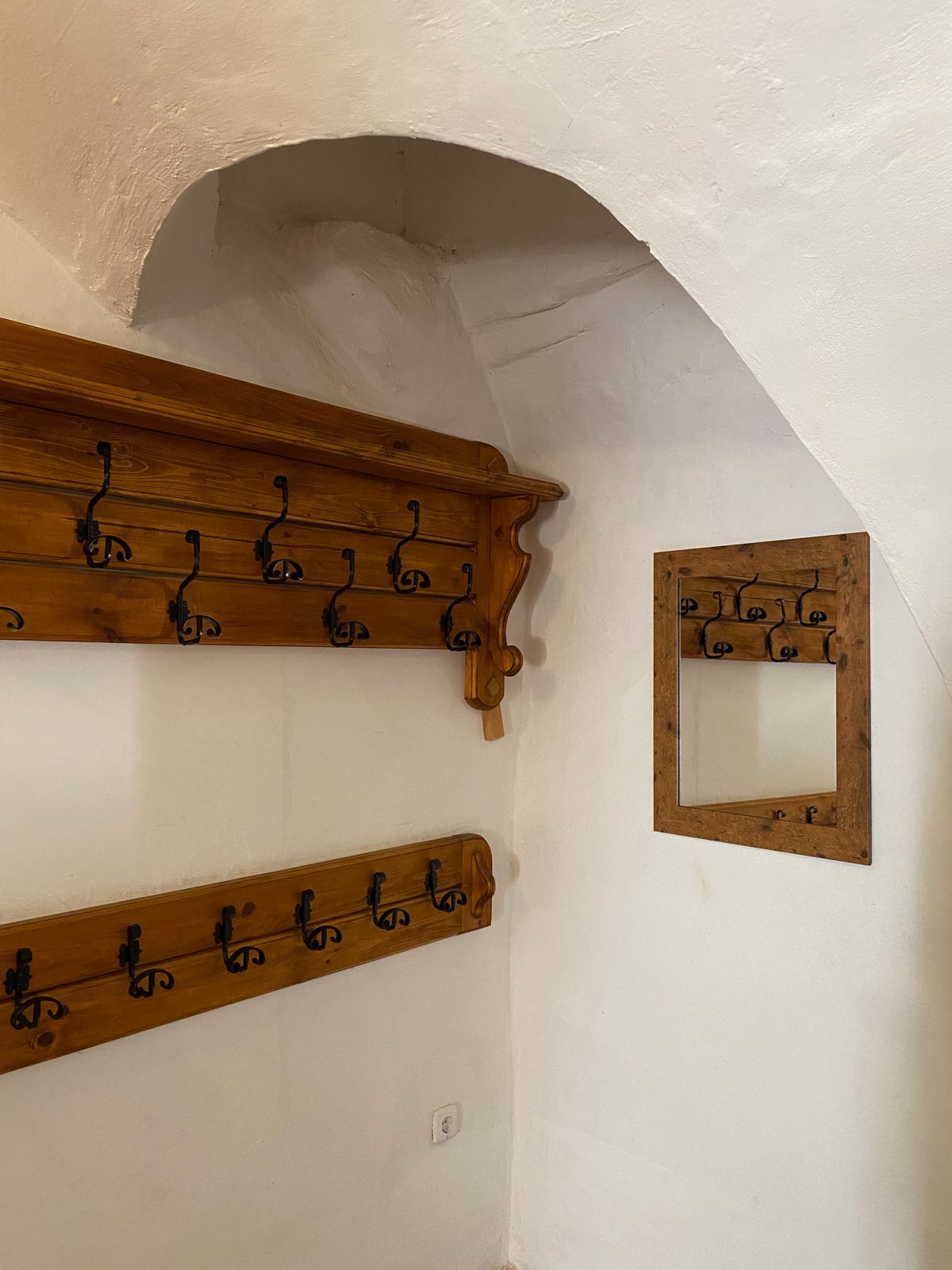
The photographs below show independent examples of real apartment entryways and conventional wall hooks. They do not depict IKEA PS 2026 or suggest an endorsement by IKEA.
- Trend signal: folding hardware that looks quiet when unused.
- Practical question: does the loaded storage preserve the route you actually walk?
- Evergreen lesson: compare the occupied footprint, not the catalogue silhouette.
Measure the wall before comparing hook designs
Start with a quick sketch of the entry. Mark the door leaf at its fully open position, switches, sockets, radiators, the edge of any cabinet and the portion of wall you can reach without stepping into the doorway. A rail 76 cm long needs a usable run of wall, not simply a hallway that measures more than 76 cm across.
Use painter's tape to mark a 76 cm line where the proposed rail would go. Stand at the door and rehearse hanging your coat, turning toward the living area and retrieving your keys. If your hand or elbow hits a cabinet, or the rail would be behind the door swing, shift the position before buying.
Do not assume a generic installation height works for everyone. The users' reach, the length of the coats and any accessibility requirements matter more than a one-size-fits-all number.
- Available uninterrupted wall length
- Door swing and nearby handles
- Reach for every household member
- Space below for long coats and bags
The two-envelope test: folded versus fully loaded
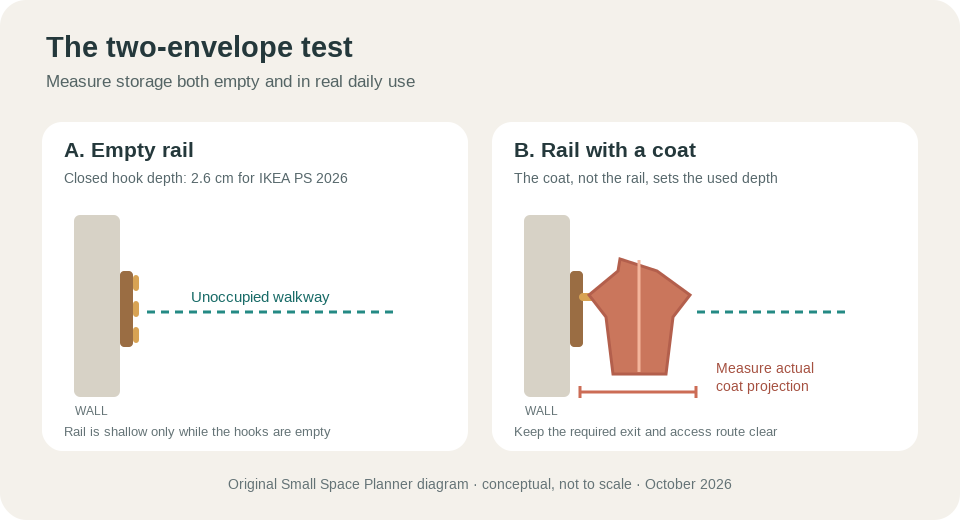
A folded rail has a small static depth. That is only the first envelope. The second envelope is the furthest point reached by the things hanging on it. A winter coat, shoulder bag or umbrella can extend much farther into a corridor than the hook body itself. Five occupied hooks can also make the wall look and feel crowded.
Measure the narrowest part of the existing clear route, then hold the bulkiest item against the intended wall and measure its actual projection. Subtract that projection from the measured clear route to see what remains at the pinch point. For example, if your own hallway has 95 cm of clear width and your own loaded coat extends 24 cm from the wall, the remaining width at that spot is 71 cm. Those figures are a hypothetical calculation, not a recommended legal clearance.
The original diagram below separates the closed-rail footprint from the real loaded footprint. It is conceptual and not drawn to scale. Any applicable exit, accessibility or building requirements take priority over a decorative storage plan.
- Envelope A: depth of the empty rail
- Envelope B: deepest real coat or bag
- Check the route at the narrowest point, not only at the rail
- Reject a layout that obstructs a required exit or access route
Compare retractable hooks, fixed pegs and a freestanding rack
Retractable hooks offer a tidier wall when unused and can be convenient for guests, scarves or occasional bags. Fixed pegs may be simpler to use when the same coat hangs there every day: the projection of a folded mechanism matters less if it is permanently loaded. Both wall-mounted options keep the floor clear but require appropriate wall attachment.
A freestanding rack avoids wall holes, which may suit renters who cannot drill, but the base and any hanging coats occupy floor space. An over-door organizer can work in some entries, but only if it does not interfere with the door's operation, fire rating, hardware or required clearance. A low-profile wall rail is not automatically the winner in every small home.
Choose based on how many items will remain hanging for most of the day. If the rail will be loaded almost continuously, prioritize the loaded shape, easy access and secure fixing rather than paying extra for the disappearing-hook effect.
- Mostly empty during the day: retractable hooks can reduce visual clutter.
- Daily heavy coats: compare actual loading and reach; fixed hooks may be sufficient.
- No permission to drill: consider stable freestanding storage outside the route.
- Very short wall: a few separated hooks may fit where a long rail cannot.
Check the weight limit without turning it into a total-capacity claim
The IKEA Spain listing states a maximum of 4 kg per hook. That is a per-hook figure, not a reason to assume the wall can safely carry five times that weight under every installation condition. The wall substrate, anchors, spacing and the maker's installation instructions determine whether the rail can be safely secured.
Weigh the heaviest everyday bag or coat if it is close to the published limit. Do not add shopping bags, backpacks or wet outerwear to a hook that already holds a heavy item. Avoid placing hooks where a child could climb on them, and do not rely on adhesive strips to replicate a product whose instructions require secure screws and plugs.
IKEA explicitly warns about falling hazards and says to use suitable screws and wall plugs, seeking professional advice when uncertain. That safety requirement matters more than the visual benefit of hidden fixings.
- Check each hook's published limit.
- Follow the exact installation instructions for your wall.
- Do not substitute adhesive mounting for screw mounting.
- Recheck security if the rail moves or the wall shows damage.
Make the hooks part of a landing zone, not the whole entryway
A rail can manage coats and bags, but it cannot organize shoes, parcels and mail on its own. Keep a small tray for keys and a defined place for the pair of shoes used most often. If your entry opens directly into a studio's living area, fewer visible objects usually do more than another decorative shelf.
Think in terms of the arrival sequence: unlock the door, hang the bag, remove the coat, put down keys and move through. If one step forces you to cross back in front of the open door, the arrangement needs revision. Our existing small-entryway storage guide covers that full sequence; this article focuses specifically on the hook decision.
Use hooks for the items you actually need near the door. Off-season coats belong in another storage zone, not on a rail that becomes a permanent second wardrobe.
- Daily outerwear only
- One reliable key location
- Shoes outside the main route
- Seasonal overflow stored elsewhere

What renters should do before drilling
Read your lease or building rules before installing anything into a wall. Some rentals allow small screw holes with repair on departure; others require permission. A wall that appears solid may contain services or require a different anchor system. The product's concealed hardware does not make installation non-invasive.
If drilling is prohibited, measure a slim freestanding alternative or use an existing permitted closet. An over-door hook is not automatically safe on a fire-rated or tight-fitting entrance door. Test the door's full operation with the actual organizer and its load before considering it.
If you can drill but expect to move soon, keep the assembly instructions and note the hole locations. A rail that fits one apartment's available wall may not fit the next.
- Lease and wall material checked
- Mounting hardware and services considered
- Door and exit operation unaffected
- Removal or future relocation planned
A five-minute buying decision you can repeat
Before ordering, draw a line for the rail, hang or hold the bulkiest everyday item at the proposed location, and walk the actual route with the entrance door open and closed. If the item touches your shoulder, catches the door or blocks a switch, change the position or the storage type.
Next, count the hooks you genuinely need. One hook per person is not always enough if bags and jackets need separate places, but more hooks do not solve a lack of loaded clearance. Check the official model's dimensions, wall fixings, stated limits and return policy, and only then compare price and finish.
The best outcome may be to buy nothing: move an existing rail away from the door swing, rotate off-season coats into a closet or replace a floor-standing rack with an existing wall hook in a better position. Small-space design should solve a daily movement problem before it adds another product.
- Tape the exact rail length on the wall.
- Test with the bulkiest real coat or bag.
- Check door swing and minimum usable route.
- Confirm drilling permission and safe fixings.
- Compare alternatives before purchasing.
Before you finish
- Measured available wall run and rail dimensions
- Door swing and switches checked
- Loaded projection measured with a real coat or bag
- Clear exit route preserved under applicable requirements
- Hook count and per-hook load limits checked
- Wall substrate, fasteners and lease rules confirmed
- Daily landing-zone items assigned a place
- Official product listing checked for local availability and changes
Small Space Planner combines measured furniture footprints, circulation-first planning and practical renter constraints. Numerical product dimensions should always be checked against the exact manufacturer model, your lease and your building conditions.
Read our editorial and research policy →Sources & further reading
For safety, building-system or health-related points, we prefer primary public-agency guidance.
Turn the advice into a measured starting plan.
Enter your dimensions, bed choice and priorities in the free studio planner.