Seasonal Closet Rotation in a Small Apartment: A Space-First Method
A seasonal wardrobe reset sounds simple until your only closet also holds shoes, coats and bedding. Start with a measured plan that protects daily access.
Keep everyday clothes in easy reach, transition layers nearby and genuinely off-season pieces in a clean, dry reserve area. Measure first, pack only fully dry garments and check humidity.
- Why the autumn closet swap is different in a studio
- Measure storage before buying organizers
- Use three access zones
- Calculate capacity with real garments
- Choose reserve storage by retrieval effort
- Clean and protect garments before packing
- Check humidity before choosing a container
- Compare options with a four-factor score
- Try a no-shopping 45-minute reset
Why the autumn closet swap is different in a studio
Autumn wardrobe cleanouts are timely, but most advice assumes a spare closet or attic. In a studio, one wardrobe may also hold shoes, bedding and coats. The goal is to improve daily access without blocking the bed or walking route.
Rotate with local weather rather than a fixed date. Cool mornings and warm afternoons can require both light and warm layers in the same week.
Measure storage before buying organizers
Measure usable inside width, depth and height. Note hinges, supports and space needed to pull containers out. Under a bed, measure the lowest clear point, including crossbars.
Example: a 76 cm-wide shelf can nominally hold two 34 cm-wide boxes, leaving 8 cm. Depth, height and retrieval clearance must also work. These are hypothetical dimensions, not product specifications.
Use three access zones
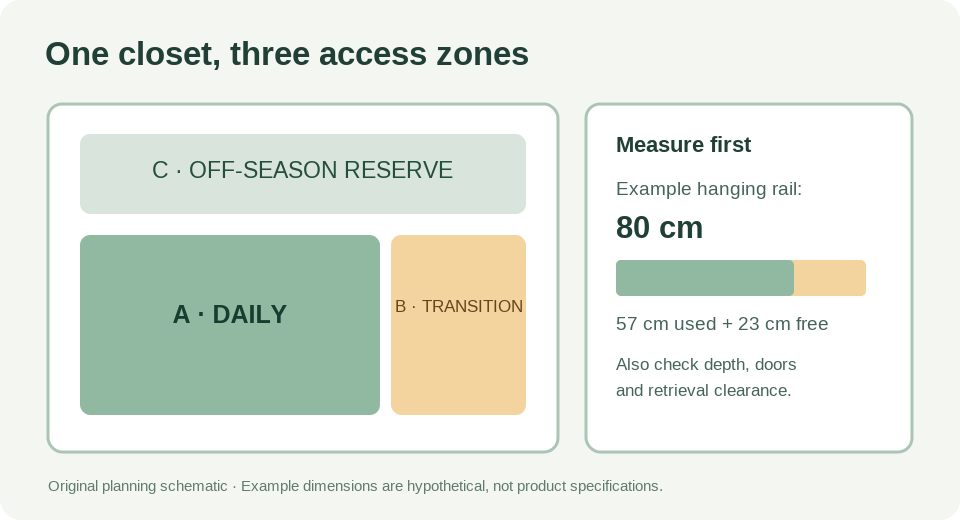
Zone A is daily reach: workwear, underwear and frequent shoes. Zone B is transition: light jackets and layers still useful in your climate. Zone C is reserve: genuinely off-season pieces and rare accessories.
These are access categories, not equal thirds of a wardrobe. Keep daily clothes one movement away; reserve items can be less convenient but must remain safely retrievable.
Calculate capacity with real garments
Measure the rail width occupied by daily clothes when hung normally and subtract it from usable rail width. Example: an 80 cm rail with 57 cm occupied leaves 23 cm for transition garments. If jackets require 28 cm, something must move or fold.
For folded items, test a comfortable stack in the actual drawer. Container volume is not proof of fit. The numbers are illustrative planning arithmetic, not tested hanger capacity.
- Rail remaining = usable width minus daily clothing width.
- Check drawer stack height and retrieval space.
- Do not block drawers or doors to gain capacity.

Choose reserve storage by retrieval effort
A high shelf preserves floor area but may be awkward for heavy boxes. An under-bed container uses existing footprint but can be blocked by supports. A dresser drawer is accessible but displaces another category. A freestanding rack is flexible but takes floor space.
Try spaces you already own before buying. Follow furniture load and anchoring instructions. Never climb unstable furniture or block an exit to make storage fit.
Clean and protect garments before packing
Clean clothes according to care labels and let them dry completely. The Smithsonian recommends clean, cool, dry and dark conditions with minimal crushing for delicate or historic textiles. Everyday clothes may be less fragile, but damp, crushed storage is still a poor default.
Fold bulky knits instead of hanging them for months on narrow hangers. Do not assume vacuum bags suit wool, down or structured jackets. Penn State Extension notes clothes-moth larvae can damage wool and other animal fibers; inspect suspect garments before storage.
Check humidity before choosing a container
The US Environmental Protection Agency warns that humidity can encourage mold on clothes in bedroom closets. Its guidance is to keep indoor relative humidity below 60%, ideally 30–50% where practical. Address leaks and damp walls before putting clothes against them.
Fabric bags, lidded bins and compression bags solve different problems. Clean, dry everyday garments may suit a bin; fragile textiles may need low-pressure storage. For an active clothes-moth problem, pest-management advice may call for cleaning and airtight containment. There is no universally best container.
Compare options with a four-factor score
Give each location zero to two points for measured fit, retrieval ease, garment protection and impact on the rest of the room. Maximum: eight. An under-bed box might save floor space yet score poorly if the bed must move for every retrieval.
This is an original planning aid, not a laboratory product rating. Safety, dampness or a blocked exit overrides any score. If options tie, prefer fewer purchases and fewer movements.
- Fit: outside dimensions and pull-out route verified.
- Access: everyday garments take one simple movement.
- Protection: clean, dry and appropriate for the fabric.
- Room impact: no blocked daily function.
Try a no-shopping 45-minute reset
Spend ten minutes identifying clothes needed now, ten measuring storage, fifteen moving only clean and dry off-season items and ten labeling and testing access. This is an example time budget, not a measured promise; separate laundry or repairs into later sessions.
Review the transition zone after two weeks. In an 80 cm wardrobe, keep daily clothes central and transition layers at one end. With 17 cm under-bed clearance, test a shallower box: a 17 cm-tall box may not slide through a 17 cm gap. These are hypothetical layouts; measure your own furniture.
Before you finish
- Measured usable dimensions and retrieval clearance
- Separated daily, transition and reserve clothes
- Tested hanging width and folded stacks
- Packed clean, fully dry garments
- Checked moisture and garment care
- Kept doors and walking routes clear
- Set a two-week review
Small Space Planner combines measured furniture footprints, circulation-first planning and practical renter constraints. Numerical product dimensions should always be checked against the exact manufacturer model, your lease and your building conditions.
Read our editorial and research policy →Sources & further reading
For safety, building-system or health-related points, we prefer primary public-agency guidance.
Turn the advice into a measured starting plan.
Enter your dimensions, bed choice and priorities in the free studio planner.