Buying Vintage Furniture for a Small Apartment: A Fit-First Checklist
Vintage wood, mixed eras and secondhand finds are appearing in fall 2026 decorating coverage. In a studio, however, a beautiful piece only earns its place if it fits the room, survives the delivery route and stays safe to use. This guide turns the trend into a practical buying decision instead of another shopping list.
Start with three pass/fail checks: the piece must fit the delivery route and working footprint, be structurally sound and safe for your household, and stay within your all-in budget. Only then compare its style or asking price. For a small apartment, one useful vintage piece usually beats several decorative purchases.

- The trend is real, but your floor plan comes first
- Apply three hard gates before you negotiate
- Measure the delivery route, not just the room
- Calculate the working footprint with an example
- Inspect structure before surface finish
- Check pests and recalls before bringing anything home
- Use the total-cost test, not the listing price
- Choose a single vintage anchor piece
- Score two candidates only after the hard gates pass
- Do a 30-minute tape test before paying
- When to walk away
The trend is real, but your floor plan comes first
October 2026 decorating coverage highlights the return of vintage wood, collected pieces and mixed furniture eras. Those are style observations, not proof that a particular antique is a good purchase. A small apartment has less room to absorb an oversized or awkward object.
Treat the trend as permission to reuse something well made, not pressure to buy. Choose the function first: closed storage, a dining surface, a reading light or a place to put your keys. If you cannot name the job the piece will do, postpone the purchase.
- Best first candidates: a compact sideboard, a sturdy small table or a low storage cabinet.
- Higher-effort candidates: large armoires, heavy glass display cabinets and deep sofas.
- Do not let a decorative item compromise access to storage, exits or everyday seating.
Apply three hard gates before you negotiate
A high score on style cannot offset a failed safety or access test. Write down three checks before visiting a seller and mark each PASS, UNKNOWN or FAIL. Treat UNKNOWN as a reason to inspect further, not as a pass.
- Fit: the item can enter the building and sit in the room with doors, drawers and walking routes usable.
- Condition and safety: the frame is sound, the item is not subject to an unresolved recall, and any required wall anchoring can be installed correctly.
- All-in cost: purchase, delivery, repair and setup fit the money you have actually set aside.

Measure the delivery route, not just the room
Record the narrowest doorway, hallway turns, elevator or stair landing and apartment entry. A cabinet narrower than a doorway can still fail at a tight turn, especially if its legs or top cannot be removed. Do not assume a diagonal measurement guarantees passage: rotation needs space in three dimensions.
Ask the seller for actual width, depth, height and approximate weight, plus whether legs, shelves or handles can be removed safely. Photograph the narrow points along your route and compare the measurements before arranging transport. Measure again if an item has projecting trim or hardware.
- Door clear opening, not the nominal door size.
- Hallway width and turning space at corners.
- Elevator interior and door opening, or stair landing dimensions.
- Whether the item must be tilted and whether that is safe for its construction.
- Vehicle capacity, safe lifting help and any building delivery rules.
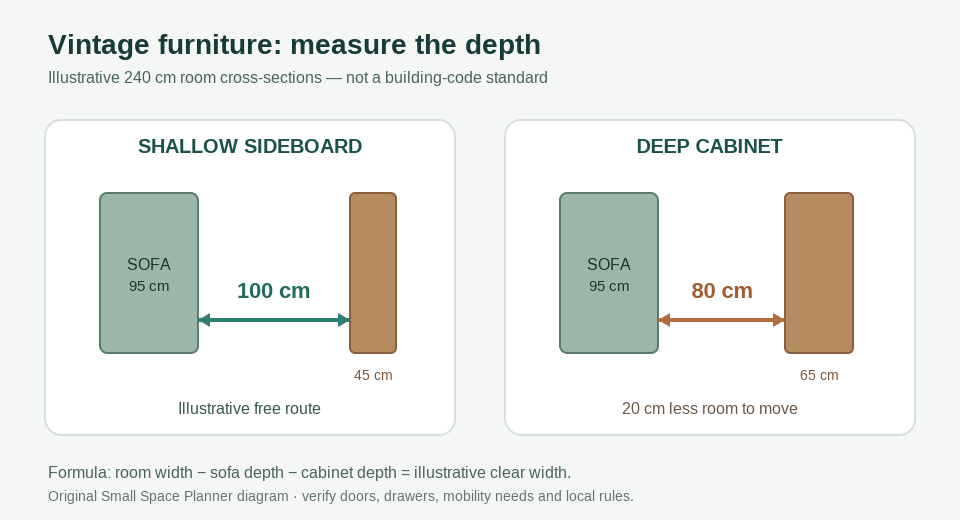
Calculate the working footprint with an example
Imagine a 240 cm (about 94.5 in) wide room. A sofa projects 95 cm from one wall. A 45 cm deep vintage sideboard on the opposite wall leaves 240 − 95 − 45 = 100 cm (about 39.4 in) between them. Replacing it with a 65 cm deep cabinet leaves only 80 cm (about 31.5 in). That 20 cm difference can change how the room works even though both items technically fit.
These numbers are an illustrative planning comparison, not a universal accessible-route or building-code clearance. Check the requirements that apply to your household, lease and building. Repeat the calculation with drawers open, chairs pulled back and doors you use daily. The best purchase is the one that works while in use, not only while closed.
- Measure depth including handles, legs and projecting tops.
- Tape the footprint on the floor and estimate drawer or door reach.
- Test the path carrying a laundry basket or shopping bag, not only walking empty-handed.
Inspect structure before surface finish
A scratch can be cosmetic; a loose frame or failing joint can make an item unsuitable. Ask permission to open every drawer and door, check that the piece stands level, look underneath and behind it, and examine joints for separation. Do not force stuck drawers or attempt repairs at the seller’s home.
Look for water swelling, crumbling particleboard, unstable legs, broken glass, exposed sharp edges, damaged fasteners and persistent musty odors. Solid wood and veneer can both be worthwhile, but neither is automatically durable. If a structural defect needs professional assessment, price the work before committing.
- Drawers travel smoothly and stop as designed.
- Back panel and frame are attached, not bowing or separating.
- No evidence of active moisture damage, pests or crumbling materials.
- No wobble, cracked support or missing load-bearing hardware.
- Have old electrical lamps checked by a qualified person before use.

Check pests and recalls before bringing anything home
The US Environmental Protection Agency advises checking secondhand furniture, beds and couches for signs of bed bugs before bringing them into the home. Inspect seams, crevices, undersides and upholstered joins; if you suspect an infestation, do not bring the item inside and seek qualified pest guidance. A quick visual inspection reduces uncertainty but cannot guarantee a pest-free item.
For dressers and other storage furniture, search the US Consumer Product Safety Commission recall database by brand, model and any label you can find. Secondhand status does not erase a recall. The CPSC Anchor It campaign advises securing furniture with drawers, doors and shelves to the wall to reduce tip-over risk. Follow the item and anchoring hardware instructions; do not treat a wall strap as a remedy for a recalled item unless the recall specifically says so.
If you rent and cannot install an appropriate anchor, do not assume a tall dresser is safe simply because it feels heavy. Choose a different piece or resolve permitted anchoring with the landlord and qualified installer before use.
- Ask for maker/model labels and a clear photo of the back.
- Search current recall notices, including any remedy instructions.
- Check fabric seams, joints and hidden surfaces for pests.
- Verify that anchoring hardware is compatible with the wall and item.
- Keep children away from unsecured or recalled storage furniture.
Use the total-cost test, not the listing price
Compare the entire purchase, not just the bargain tag. A hypothetical $120 sideboard plus $65 transport, $45 repair materials and $30 for appropriate setup costs $260. A different $230 item delivered and ready for use could be cheaper overall. Neither number is a market price estimate; substitute actual quotes for your location.
Also consider time, stairs, disposal of your existing item and whether you can resell or move the purchase later. Repairs are not always economical, and a one-of-a-kind listing does not justify skipping a cost check.
- Purchase price + transport + professional help + repair + safe setup = all-in cost.
- Ask for written measurements and condition photos before paying.
- Agree on collection, payment and cancellation terms before booking transport.
- Leave a contingency for defects you cannot inspect without disassembly.
Choose a single vintage anchor piece
In a one-room home, a useful statement piece can carry the look without filling every corner. A compact low sideboard can hide paperwork and chargers; a small round table can work for meals and a laptop; a modest framed mirror can add character if mounted safely. Choose based on the function you actually need.
Mixing old and new is easier when the vintage piece shares one element with the room—wood tone, hardware color or silhouette—rather than trying to match every object. Use textiles and removable accessories for the rest of the look; they are easier to change when the trend passes.
- Choose low, shallow storage when tall pieces would block light or require difficult anchoring.
- Prefer furniture with a simple footprint and accessible storage.
- Avoid buying decorative objects before solving seating, work and storage needs.

Score two candidates only after the hard gates pass
For pieces that pass fit, safety and budget, use this editorial scorecard. Rate each criterion 0 (poor), 1 (acceptable) or 2 (strong): daily function, access, condition, flexibility for a future move and appearance. Ten points is the maximum; the score is a personal decision aid, not a scientific product rating.
Example: Candidate A, a shallow sideboard, scores 2 + 2 + 2 + 2 + 1 = 9. Candidate B, a deeper ornate cabinet, scores 2 + 0 + 2 + 0 + 2 = 6. If B also blocks a necessary path, it fails the fit gate regardless of its score. Adjust the criteria for your routines, but never trade away a safety requirement for aesthetics.
- 0–2: Daily function
- 0–2: Access while open and in use
- 0–2: Structural condition
- 0–2: Moveability and adaptability
- 0–2: Visual fit with the room
Do a 30-minute tape test before paying
Mark the item’s width and depth on the floor with removable painter’s tape. Walk from the entrance to the kitchen, bathroom and bed. Pull out a chair, open the nearest door and mimic reaching the item’s drawers. If it replaces existing furniture, mark the old and new footprints in different tape patterns.
If the seller cannot hold the piece, take the measurements home and repeat the test before deciding. A missed bargain costs less than an oversized object you cannot return. When uncertain, choose the smaller, safer option or wait for another listing.
- Five minutes: verify the listing dimensions and room sketch.
- Ten minutes: tape the closed footprint and drawer reach.
- Ten minutes: walk three daily routines and test door swings.
- Five minutes: confirm delivery, recall status and full budget.
When to walk away
Skip the item if the seller cannot explain a significant structural defect, the delivery route is unworkable, the upholstery shows possible pest activity, a recall has no appropriate remedy, or safe anchoring cannot be arranged. A trend is never a reason to accept a preventable hazard.
The most sustainable choice may be to keep a working piece you already own. Repairing, rearranging or refinishing within safe limits can deliver a vintage-inspired room without purchasing anything new.
Before you finish
- The piece has a specific daily job
- Exact dimensions and delivery route checked
- Closed and open footprint tested
- Frame, joints, drawers and surfaces inspected
- Secondhand pest check completed
- Recalls and anchoring requirements reviewed
- All-in cost compared with alternatives
- Tape test passed without blocking essential routes
Small Space Planner combines measured furniture footprints, circulation-first planning and practical renter constraints. Numerical product dimensions should always be checked against the exact manufacturer model, your lease and your building conditions.
Read our editorial and research policy →Sources & further reading
For safety, building-system or health-related points, we prefer primary public-agency guidance.
Turn the advice into a measured starting plan.
Enter your dimensions, bed choice and priorities in the free studio planner.