Small-Apartment Holiday Decor 2026: Celebrate Without Losing Floor Space
Holiday collections are arriving in October 2026, including IKEA's VINTERFINT and STRÅLA ranges. The season's folklore-inspired and playful decorations look inviting, but a studio has a different challenge from a showroom: every tree base, gift pile and extra chair competes with daily movement. Here is a measured, renter-aware way to make a compact home festive without surrendering the floor.
Decorate existing vertical surfaces and furniture first. Protect the route to the door, kitchen and bathroom; choose a tabletop tree, window star or shelf garland before buying a full-size tree. Check the complete footprint and safe electrical placement, then reserve one small box for everything you will need to store after the holidays.

- Start with the square footage you cannot give away
- Choose the holiday display by its true footprint
- Use the 2026 trend as a palette, not a shopping list
- Make one window and one shelf do the work
- A three-zone layout test for studios
- Plan for guests without sacrificing the everyday room
- Calculate the January storage cost before buying
- Keep festive lighting and trees safe
- A 30-minute no-purchase trial
Start with the square footage you cannot give away
Sketch your studio and mark the route between the entrance, bathroom, kitchen and sleeping area. Add door swings, a pulled-out dining chair, a wardrobe door and any heater. These are working spaces, not decorating opportunities. A display that blocks one of them fails even if the tree itself looks narrow.
Photograph the room before moving anything. Identify a shelf, windowsill, console or existing side table that can carry a seasonal accent without requiring another furniture purchase. Do not use a windowsill or radiator cover if the display interferes with safe operation, ventilation, access or the manufacturer's instructions.
- Mark entrances, exits and door swings first.
- Measure the widest part of any tree or display, not just its advertised height.
- Keep frequently used drawers and windows usable.
- If you need to move a piece of furniture every day, the display is probably in the wrong place.
Choose the holiday display by its true footprint
A full-size tree is one option, not the default. Compare four arrangements by the floor they occupy, how they are accessed and where they will be stored in January. A narrow tree still needs a stable base and room for branches, ornaments and people passing nearby.
Example only: if an available corner is 70 by 70 cm, its area is 0.49 square metres. A tree with a 90 cm-wide branch spread does not fit that corner simply because its stand is smaller. Measure the actual product and leave the surrounding clearance required for safe use and your own route.
- Tabletop tree: uses an existing stable surface; check tipping risk and whether you still need that surface.
- Wall or window display: preserves the floor; use suitable fixtures and respect rental rules.
- Slim floor tree: gives height, but measure maximum branch width, base and electrical route.
- Shelf garland: works when the shelf remains usable and nothing hangs into a walkway.
Use the 2026 trend as a palette, not a shopping list
IKEA describes its 2026 winter collections through two expressions: Scandinavian folklore, with familiar seasonal colours and motifs, and a brighter 'Happy Carnival' approach. VINTERFINT covers decorations and tableware, STRÅLA seasonal lighting and VINTERSAGA treats. Availability and prices vary by country and store, so treat the announcement as design context rather than proof of stock.
To borrow the idea without filling a studio, choose one expression and apply it to two places you already see: for example a paper star in the window and a small red-and-green arrangement on a shelf, or one playful colour on cushion covers and a reusable gift wrap. If you already own suitable decorations, start there.
- Folklore direction: repeat a limited number of warm, traditional tones.
- Playful direction: choose one bright accent rather than buying every novelty.
- Both: favour removable, reusable items with a known storage home.
Make one window and one shelf do the work
A window can create an evening focal point without taking away floor area. First decide whether the light will be visible from your usual seat and whether the window must open. A star lantern, paper decoration or approved indoor light may be enough; do not suspend heavy objects from weak fittings or route wires through moving window frames.
A shelf can replace a mantel in a small home. Try a short garland or two small ornaments at one end rather than covering every book or creating an unstable stack. Keep shelves and nearby lighting within their intended load and heat limits. Photographs of larger rooms are inspiration for placement, not evidence that a particular arrangement will fit yours.
- Decorate one existing surface per zone, not every available surface.
- Prefer a lightweight accent over another floor-standing object.
- Test the display from the doorway and sofa before buying a second piece.

A three-zone layout test for studios
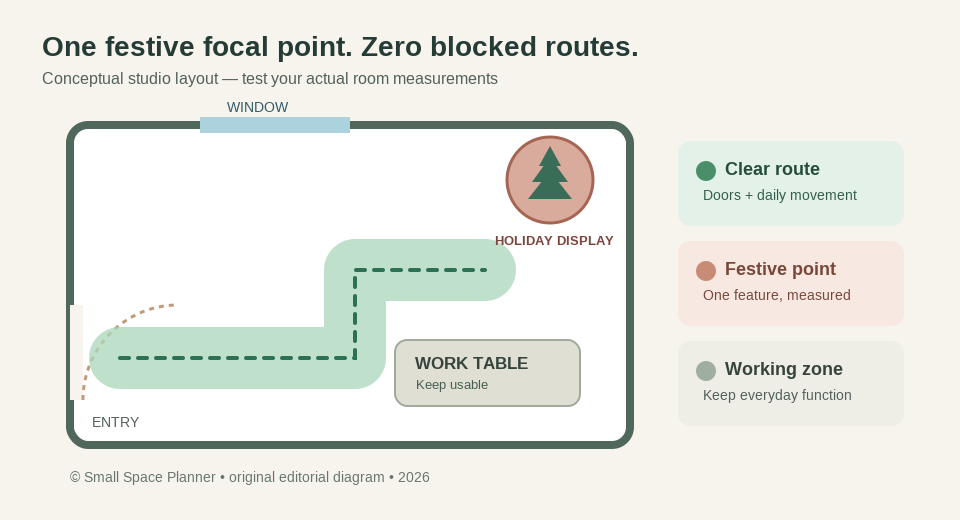
Divide the room into a clear route, a festive focal point and a working surface. In the example diagram below, the tree or seasonal display sits outside the main route. The diagram is conceptual, not a scaled building plan or a universal clearance specification.
Walk the space carrying a laundry basket and then pull out a dining chair. Open the bathroom door and wardrobe. If the display survives those everyday actions without being touched or moved, it has earned its place. If not, shift it to the shelf or window.
- Route: uninterrupted movement to essential doors and appliances.
- Focal point: one visible holiday feature in a low-conflict location.
- Working surface: keep the table, desk and kitchen prep area usable.
Plan for guests without sacrificing the everyday room
In a studio, a gathering can change the traffic pattern more than the decor does. Move fragile ornaments away from the edge of the coffee table, choose a serving area that does not block the kitchen, and keep bags and coats out of the entrance route.
Use what you already own: a dining table can become the shared surface, while one tray gathers decorations and can be lifted away when food arrives. The best festive layout converts back to normal living in a few minutes.
- Do a door-to-bathroom walk-through with chairs pulled out.
- Keep one clear place for guests' belongings.
- Choose a removable tabletop display over permanent rearrangement.

Calculate the January storage cost before buying
Holiday decor is not free space just because it is seasonal. Measure the folded dimensions of the tree, garland, lights and storage box before purchasing. A collapsible decoration is only compact if its packed size fits your actual closet, bed clearance or shelf.
Try a one-box rule: put existing decorations in the container you are willing to store all year, and buy only replacements or additions that fit when everything is packed. This is an editorial decision aid, not a requirement. Label cords separately from fragile pieces, and keep the container somewhere accessible without blocking other essentials.
- Write down the packed length, width and height.
- Confirm where the box will live for the other eleven months.
- Prefer one meaningful addition to several single-use novelties.
- Reuse packaging that protects fragile decorations.
Keep festive lighting and trees safe
The U.S. Fire Administration advises keeping Christmas trees away from heat sources and out of exits, checking lights for damage, following manufacturers' connection limits and watering live trees daily. Its published guidance specifies at least 3 feet between a tree and heat sources. Local rules and product instructions still apply.
The Electrical Safety Foundation International warns against routing decoration cords beneath rugs or furniture, through windows or across walkways. Inspect lights, use products rated for their location, avoid overloaded sockets and turn decorative lighting off when leaving or sleeping. Battery-powered flameless candles avoid the open flame of traditional candles.
- Never put a tree or decorations in an exit route.
- Keep cords out of walkways, rugs and pinching points.
- Follow each light set's stated electrical limits.
- Avoid open flames near textiles, greenery and decorations.
- Secure or avoid small, fragile items where children or pets could reach them.
A 30-minute no-purchase trial
Spend ten minutes clearing the route and selecting one existing surface. Spend ten minutes trying two layouts with decorations you already have: one window-and-shelf version and one compact-tree version if you own a tree. Spend the final ten minutes checking electrical access, daily use and the storage box.
Take a photo from the same spot before and after. If the display makes the room feel festive while keeping movement, light and surfaces practical, stop there. Seasonal design should add joy, not another furniture problem.
- Clear the walking route.
- Try two reversible display positions.
- Test doors, chair movement and sockets.
- Confirm a January storage home.
- Only then decide whether anything is missing.
Before you finish
- Essential routes and door swings stay clear
- Decor measured at its widest and in its stored form
- One window or shelf used before adding floor furniture
- 2026 colour palette chosen without unnecessary purchases
- Electrical cords and heating clearance checked
- Tree stability and child/pet access considered
- Guests can move around with chairs in use
- Everything fits a planned storage box
Small Space Planner combines measured furniture footprints, circulation-first planning and practical renter constraints. Numerical product dimensions should always be checked against the exact manufacturer model, your lease and your building conditions.
Read our editorial and research policy →Sources & further reading
For safety, building-system or health-related points, we prefer primary public-agency guidance.
- IKEA Global — Winter celebrations 2026 (8 Sep 2026) ↗
- IKEA Canada — 2026 holiday collections (1 Oct, updated 6 Oct 2026) ↗
- The Spruce — IKEA holiday collection 2026 editorial coverage (19 Oct 2026) ↗
- U.S. Fire Administration — Holiday fire safety (reviewed 7 Oct 2026) ↗
- Electrical Safety Foundation International — Holiday decoration cords ↗
Turn the advice into a measured starting plan.
Enter your dimensions, bed choice and priorities in the free studio planner.