Floral Prints in a Small Apartment: A 2026 IKEA-Inspired Guide Without Visual Clutter
IKEA's October 2026 collection puts botanical prints on sofa covers, cushions and bedding, even as autumn begins. The interesting question for someone in a studio is not whether florals are fashionable; it is how a pattern can give a one-room home character without turning the sofa, bed, curtains and rug into competing focal points. This practical guide uses the launch as a prompt for a low-cost, reversible textile plan.
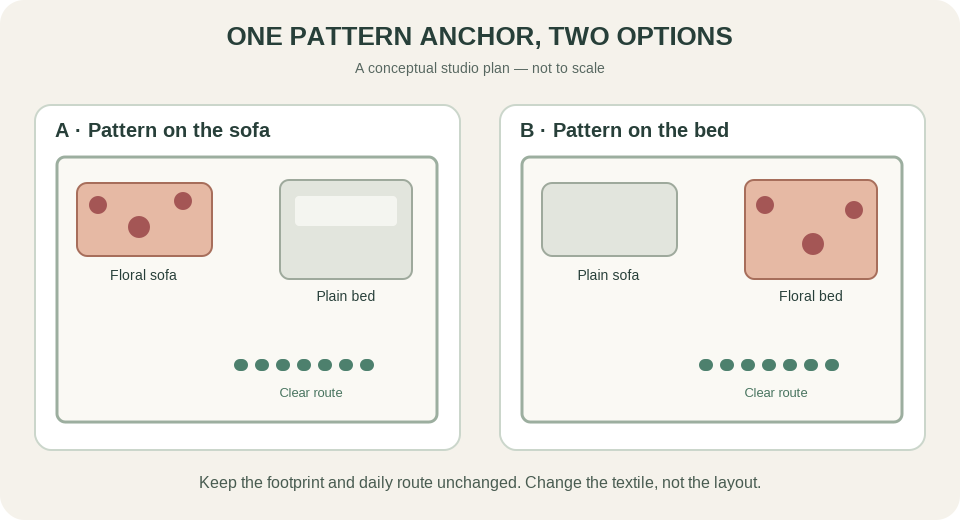
Start with one patterned textile you already own or actually need: a cushion cover, duvet cover or washable sofa cover. Repeat one color from it in plain textiles, leave at least one large visual surface quiet, and check dimensions, cleaning instructions and daylight before buying. In a studio where the bed and sofa are both visible, make only one of them the dominant print.

- What actually changed in October 2026
- Choose one print anchor before choosing a color
- Use the two-surface test
- Match print scale to what you see, not to square footage alone
- Make floral cushions work harder than a new chair
- Use floral bedding when the bed doubles as a living-room view
- Think carefully before putting a floral pattern at the window
- Try a no-buy botanical refresh first
- A measured buying checklist for real apartments
What actually changed in October 2026
In its October 2 announcement, IKEA Spain introduced more than 40 nature-inspired additions, highlighting dusty pink, mustard yellow and dark blue. The release includes Hanna Wendelbo's MÅNGBYN cover designed for EKTORP sofas, Lina Schnaufer's ARENBOK and PJÄXE bedding, and Emma Prowse's KRONBUSKE bedding. These are examples of a broader floral direction, not proof that every item is sold in every market or fits every sofa.
The launch is an opportunity to reconsider textiles rather than replace furniture. A cover can refresh an existing sofa, and bedding can change the mood of a sleeping zone without adding a chair or shelf. For a rental or studio, that matters more than the seasonal label. The photographs in this guide are independent examples of floral interiors, not IKEA product photography.
- Trend signal: botanical prints on everyday textiles, not just decorative accessories.
- Useful small-space angle: change a surface you already have instead of adding furniture.
- Check current stock, product compatibility, measurements and fabric care on the local retailer's page.
Choose one print anchor before choosing a color
Stand in the doorway and note the two or three largest things you see: perhaps a sofa, the bed and a window. Pick one of those to carry the main floral pattern. A small studio rarely needs three equal-strength statements. This is a visual planning technique, not a scientific rule about how large a room appears.
If the bed is visible from the living area, patterned bedding is often enough. If the bed is tucked behind a curtain or alcove, one floral sofa cushion or removable cover can become the main feature. If your furniture is already patterned, a floral curtain may create unnecessary competition; keep the window treatment quiet.
- Bed visible from sofa: patterned duvet OR patterned sofa, not automatically both.
- Neutral sofa and neutral bed: try one removable floral cushion before a full slipcover.
- Existing busy rug or wallpaper: borrow one color from it and use smaller, simpler florals—or skip them.
Use the two-surface test
Place the candidate floral textile on its intended surface and photograph the room from the entrance and from your usual seat. Cover the other major textile surface with something plain. The aim is to see whether the eye can settle on one feature while the room remains functional.
Compare two layouts in the original diagram: Option A makes the sofa the patterned focal point and keeps the bed plain; Option B does the reverse. Neither option adds a new furniture footprint. If both look too busy in your own photographs, start with a single cushion rather than a full cover.
- One main printed surface; one visually calm companion surface.
- Repeat a color once on an existing object, not in a new purchase by default.
- Review the room in daylight and at night; patterns read differently under artificial light.
Match print scale to what you see, not to square footage alone
A tiny repeat on a large duvet may read as texture from across the room, while large high-contrast flowers can become a focal point even on one cushion. There is no universal 'small prints for small rooms' law. Distance, contrast, background color and the proportion of fabric you see matter more than a label.
Compare sample images at the distance from which you actually view the bed or sofa. If you are shopping online, inspect the photographed repeat size against a pillow or mattress dimension and request a swatch where possible. Zoomed-in product photographs often conceal how busy a pattern looks over two metres of fabric.
- Fine repeat + similar background colors: often reads as quieter from a distance.
- Large blooms + strong contrast: use deliberately as one feature.
- Avoid deciding from a close-up swatch alone; look for a full-room image and real measurements.
Make floral cushions work harder than a new chair
The lowest-risk trial is often a washable cushion cover on a cushion you already own. Choose a print with at least one color found elsewhere in the room—perhaps the sofa, floor or curtains. A second plain cover in that color is optional; the point is to connect the print to the room, not to buy a matching set.
Before ordering, measure the insert and confirm the cover size, closure and care label. A decorative cushion that must live on the floor every night has failed the studio test. Keep the number of cushions low enough that everyone can sit comfortably without moving a pile.
- Use an existing cushion insert if possible.
- Check dimensions and laundering instructions before purchasing.
- Sit down normally; if cushions obstruct the seat, remove one.

Use floral bedding when the bed doubles as a living-room view
In many studios, the bed is the largest uninterrupted fabric area. That makes bedding a powerful but reversible way to use the 2026 floral direction. A duvet cover changes the view without taking additional floor area. Choose a calmer plain sheet, pillowcase or throw if the floral duvet already carries a strong pattern.
Check whether the product is sold as a cover alone or a set, and match its actual dimensions to the duvet and pillow sizes you own. The fabric blend and care instructions matter if the bed is used daily, especially when there is no separate laundry room. Do not infer fabric performance from the collection's marketing imagery.
- Use the bed as the print anchor only if it is a major sightline.
- Keep one companion textile plain to avoid competing repeats.
- Check the care label and laundry capacity before choosing delicate fabrics.
Think carefully before putting a floral pattern at the window
Curtains occupy a tall visual plane, so a strong print can dominate a compact room even without using floor space. Before buying, check how the pattern looks both open and closed, whether the curtain blocks a heater or opening window, and whether its opacity gives you the privacy and daylight you need.
In a one-window studio, preserving useful daylight may matter more than adding another decorative motif. If the sofa or bed already carries a floral pattern, plain or lightly textured curtains are often the easier choice. Follow mounting instructions and rental rules; removable tension systems must still be suitable for the load and opening.
- Measure curtain length and stack-back, not only the window width.
- Check privacy, light filtering, heating and window operation.
- Keep existing plain curtains if another surface already supplies enough pattern.

Try a no-buy botanical refresh first
Gather the patterned pieces you already own—bedding, cushions, tea towels or a small tablecloth. Choose one item to move into the most visible location if it belongs there and can be used safely. Fold or store the competing items rather than displaying them all at once. Photograph the result and live with it for three days.
A studio can gain seasonal character from a change in placement, not a shopping trip. If you do buy something, replace a worn or unsuitable textile rather than adding a fifth decorative layer. Keep packaging only if it helps protect the item for the next season, and plan where off-season pieces will live.
- Inventory before shopping.
- Swap rather than stack; one item in, one item stored or retired.
- Give seasonal textiles a defined storage location.
A measured buying checklist for real apartments
For each potential purchase, record the item you would replace, the visible dimensions, its care requirements and where it will live when not in use. A full sofa cover also requires a compatibility check: even a cover advertised for a particular model may vary by sofa version, arm style or market.
For example, a hypothetical 45 × 45 cm cushion cover can fit an existing insert of the same stated size, but a duvet cover labeled for a different market may not match your actual duvet. Check each product's published measurements rather than treating these examples as universal standards. If you cannot name the surface it improves and where the old item goes, wait.
- One specific use and one specific surface.
- Actual measurements and compatibility checked.
- Laundry, cleaning and return policy understood.
- No blocked window, exit, radiator or daily routine.
- A place for the replaced textile is identified.
Before you finish
- One focal printed surface chosen from the doorway view
- Other major fabric surface kept relatively calm
- Pattern tested from normal viewing distance
- Dimensions, compatibility and care label verified
- Window light and access unaffected
- Existing textiles audited before shopping
- Seasonal storage and returns considered
Small Space Planner combines measured furniture footprints, circulation-first planning and practical renter constraints. Numerical product dimensions should always be checked against the exact manufacturer model, your lease and your building conditions.
Read our editorial and research policy →Sources & further reading
For safety, building-system or health-related points, we prefer primary public-agency guidance.
Turn the advice into a measured starting plan.
Enter your dimensions, bed choice and priorities in the free studio planner.